

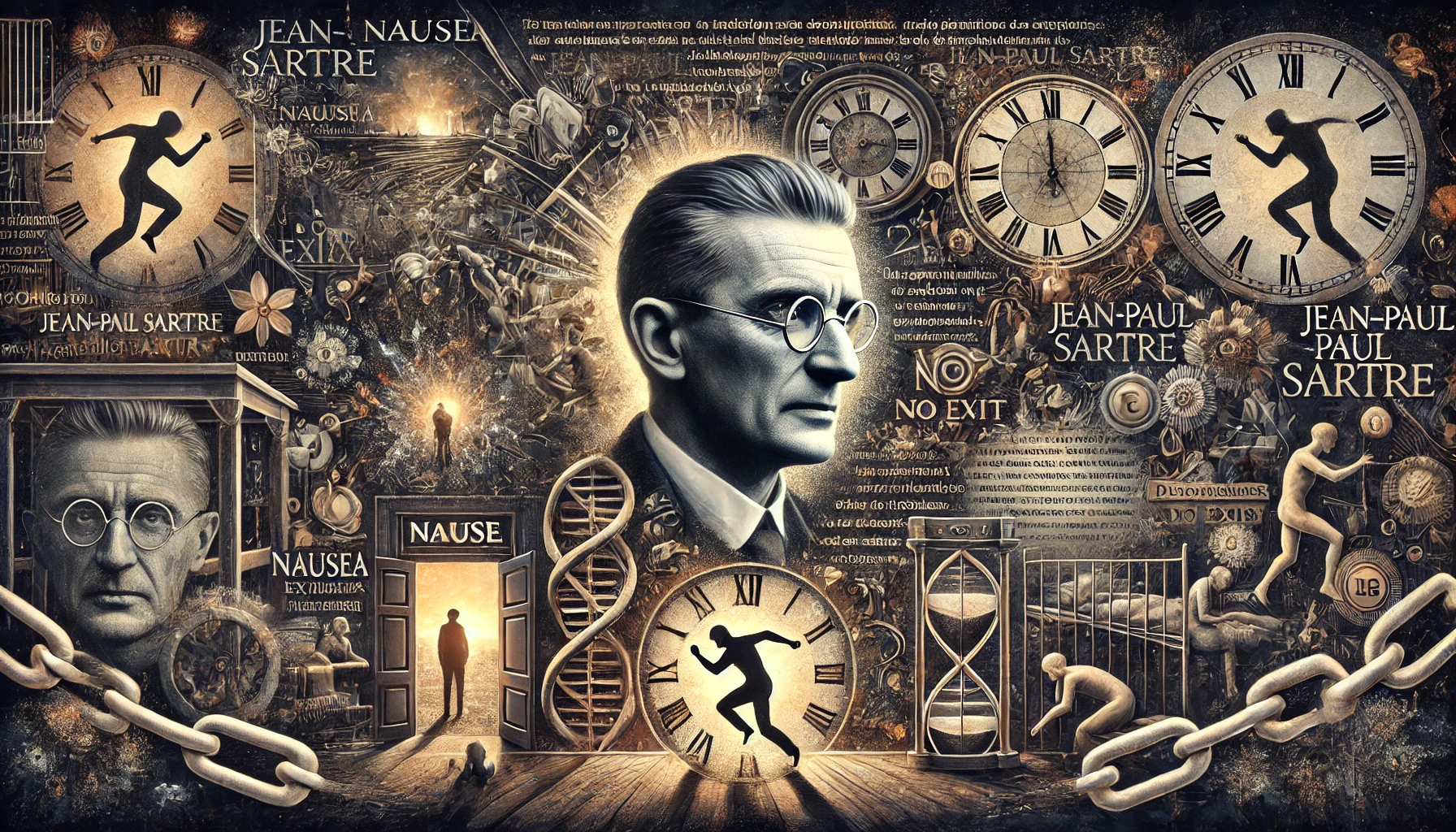
Jean-Paul Sartre, a towering figure of modern philosophy, left an indelible
mark on literature and thought with his unique take on existentialism. His
work navigates the complex terrain of free will, authenticity, and the nature
of human existence. Through novels, plays, short stories, and philosophical
lectures, Sartre invites readers to confront profound questions about life,
choice, and meaning.
Sartre’s philosophy is rooted in the idea of total and complete free will within
an indifferent reality (Law, 2007). He posited that human beings are not
bound by predetermined nature or divine plans but are instead radically free
to define their essence through actions. This freedom, however, brings with it
a heavy burden of responsibility and existential angst.
His first novel, Nausea, explores this existential crisis through the character
of Antoine Roquentin. Roquentin’s journey of self-discovery is marked by a
growing awareness of the arbitrary and changing nature of the world around
him. This “nausea” is not merely an internal feeling but an existential
realization—a discomfort in perceiving the stark reality of existence
unclouded by preconceived notions. As Roquentin abandons his distractions,
he confronts the core question of existence itself.
Sartre’s iconic play No Exit delves into the human condition by examining the
dynamics of interpersonal relationships. The famous phrase “Hell is other
people” encapsulates Sartre’s view on the inauthenticity that arises when
individuals live through the lens of societal expectations rather than
embracing their own subjective truth (Sartre, 1956).
The characters in No Exit are trapped in a room where their interactions
become a source of torment. Each character seeks validation from others,
only to find themselves further alienated and confined by these judgments.
The play serves as an allegory for Sartre’s philosophical exploration of how
others’ perceptions can obstruct personal authenticity.
In the short story The Wall, Sartre explores existential questions about death
and meaning. Set during the Spanish Civil War, the narrative follows three
prisoners facing execution. Each character represents a different response to
the inevitability of death: fear of suffering, resignation, and a detached
contemplation of futility.
Pablo, the protagonist, reflects on his past and the ultimate irrelevance of
memories and moral stances in the face of non-existence. This stark
realization underscores Sartre’s view of life as devoid of inherent meaning,
with existence or non-existence as the only constants.
Sartre’s lecture Existentialism is a Humanism offers a comprehensive
articulation of his philosophy. He identifies three aspects of the human
condition: anguish, forlornness, and despair. These arise from the realization
of our radical freedom, the absence of universal standards, and the
responsibility for interpreting and defining the world around us (Sartre &
Baskin, 1966).
Sartre critiques both religious and secular ethics for imposing external
standards, arguing instead for individual authenticity. For him, humans are
condemned to be free, tasked with creating their essence through choices.
This freedom, while empowering, also brings anxiety as individuals grapple
with the weight of their decisions and the realization that they alone are
responsible for their meaning.
Sartre’s literary works provide accessible entry points into his dense
philosophical ideas. Through characters like Roquentin, Pablo, and the
protagonists of No Exit, Sartre illustrates the complexities of human
existence, freedom, and responsibility. His fiction serves as a bridge, making
abstract philosophical concepts relatable and engaging.
Jean-Paul Sartre challenges us to confront the core questions of existence, to
embrace the freedom and responsibility that come with being human, and to
live authentically despite societal pressures. His philosophy is a call to action,
urging individuals to take ownership of their choices and create meaning in a
world that offers none.
Sartre’s works remain as thought-provoking today as they were in his time.
Whether through literature, drama, or philosophy, his exploration of the
human condition continues to inspire readers to reflect deeply on their lives
and choices.