Throughout history, cults and new religious movements (NRMs) have
captured the imagination and suspicion of societies. While many fade into
obscurity, others grow into major world religions. Yet in the modern era, the
term “cult” carries a heavily negative connotation, conjuring images of
manipulation, violence, and secrecy. But why is this so? How have societal
perceptions of cults shifted, and what role has media played in shaping these
views?
The term “cult” historically referred to systems of religious veneration
directed toward specific figures or objects. Ancient polytheistic traditions
often revolved around cult worship, from the rites of the Roman gods to the
tribal veneration of deities like Yahweh. Over time, some cults grew into
organized religions, as seen with the “cult of Yahweh,” which laid the
foundation for Judaism, Christianity, and Islam.
The term itself, however, began to shift in meaning during the 20th century,
particularly as NRMs began to emerge in greater numbers. Societal anxieties
about change, combined with sensationalized media portrayals, transformed
“cult” into a pejorative label associated with deviance and danger.
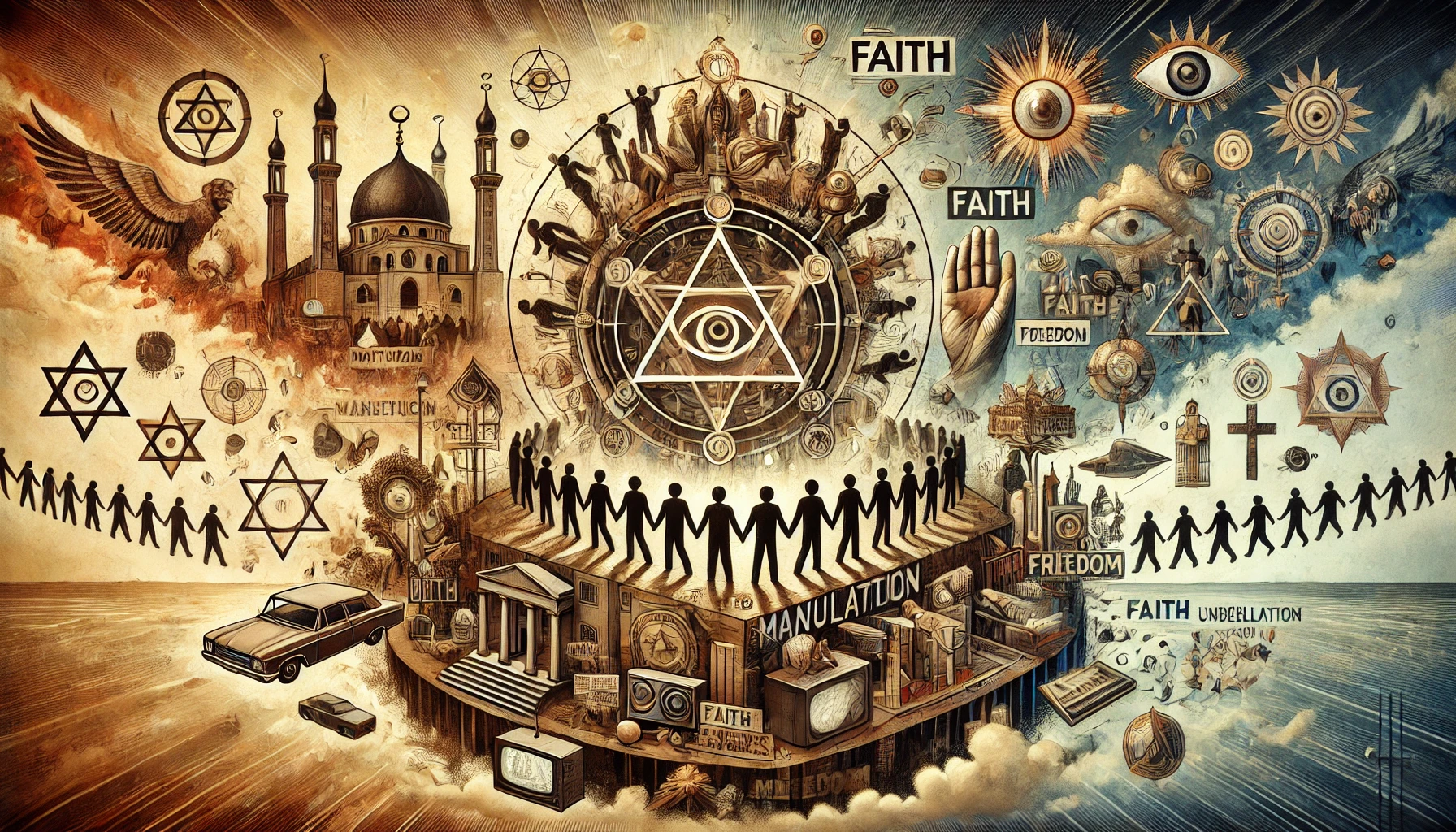
Today, cults are often associated with coercion, violence, and extremism,
thanks in large part to high-profile incidents like Jonestown, Waco, and the
allegations against Scientology. These events, magnified by media coverage,
have fueled public mistrust of NRMs. As Lynn Neal argues, television and film
have played a significant role in reinforcing these stereotypes. From the
1950s onward, cults were increasingly depicted as dangerous and morally
corrupt, often featuring themes of brainwashing, fraud, and sexual
exploitation (Neal, 2011).
Neal’s research highlights how the media acts as a “policing agent” for
religious legitimacy, portraying cults as the “religious other.” The repetitive
narrative of deviance in television and film perpetuates the idea that all cults
are inherently harmful, even though many operate peacefully and within the
bounds of the law.
One of the greatest challenges in studying cults is defining them. The Oxford
Languages definition—a system of religious veneration directed toward a
particular figure or object—could apply to most religious traditions. However,
sociologist Eileen Barker notes that modern ideology often defines cults by
their perceived social problems. NRMs are labeled cults when they challenge
societal norms or cause friction, regardless of whether they actually pose a
threat (Barker, 2010).
Barker also observes that perceptions of NRMs vary between insiders and
outsiders. Adherents often view their movement as fulfilling and meaningful,
while critics highlight its negative aspects. This subjectivity creates a
polarized discourse, further complicating public understanding.
Peter Olsen’s research underscores the power of language in shaping
perceptions. In a study conducted in Nebraska, he found that people were far
more comfortable with the idea of a neighbor joining a “new Christian
church” than a “new religious movement” or a “cult.” This suggests that
terminology carries significant weight in influencing public attitudes. The
word “Christianity,” for example, seems to confer a sense of authenticity and
legitimacy, even when applied to new movements (Olsen, 2006).
NRMs often face suspicion and resistance, particularly in societies that prize
religious freedom. In the United States, allegations of kidnapping, forced
marriages, and abuse have fueled legal and social scrutiny of NRMs, even as
the Constitution guarantees religious liberty. Barker points out that this
tension creates a cycle of mistrust: NRMs view society as hostile, while
society perceives NRMs as secretive and dangerous (Barker, 2015).
Yet, many NRMs operate peacefully and provide a sense of community and
purpose for their adherents. Examples like Raëlism—a movement centered
on achieving immortality through cloning—illustrate the diversity of NRMs
and their often misunderstood goals. Similarly, tribal cults devoted to figures
like Prince Philip or John Frum demonstrate the cultural specificity of these
movements and their capacity for coexistence without conflict.
Stereotyping all cults as harmful is not only inaccurate but also dangerous.
Many of today’s established religions began as cults, including the Jesus
movement led by Paul of Tarsus, which evolved into Christianity. Even the
most successful religions were once marginalized and viewed with suspicion.
Labeling all NRMs as dangerous overlooks their potential to contribute
positively to cultural and spiritual life. It also reinforces a narrative of
intolerance, contradicting foundational principles of religious freedom and
diversity.
The stigma surrounding cults and NRMs is a modern phenomenon, driven
largely by media portrayals and societal fears. While high-profile cases of
abuse and violence should not be ignored, they do not represent the full
spectrum of NRMs. Scholars like Barker and Neal urge us to approach these
movements with objectivity and nuance, recognizing their diversity and the
often-overlooked positive aspects of their practices.
As history shows, the line between cult and religion is not fixed. Given time
and cultural acceptance, today’s NRMs could become tomorrow’s established
faiths. By shedding the biases perpetuated by media and embracing a more
balanced perspective, society can foster greater understanding and
tolerance for all forms of religious expression.
Barker, E. (2010). The cult as a social problem. In Titus Hjem (Ed.), Religion
and social problems (pp. 198–212). Routledge.
Barker, E. (2015). The Not-So-New Religious Movements: Changes in ‘the
Cult Scene’ over the Past Forty Years. Temenos – Nordic Journal of
Comparative Religion, 50(2), 235–256. https://doi.org/10.33356/temenos.48461
Neal, L. (2011). “They’re Freaks!”: The Cult Stereotype in Fictional
Television Shows, 1958–2008. Nova Religio: The Journal of Alternative
and Emergent Religions, 14(3), 81–107. https://doi.org/10.1525/nr.2011.14.3.81
Olsen, P. J. (2006). The Public Perception of “Cults” and “New Religious
Movements.” Journal for the Scientific Study of Religion, 45(1), 97–106.
https://doi.org/10.1111/j.1468-5906.2006.00008.x