
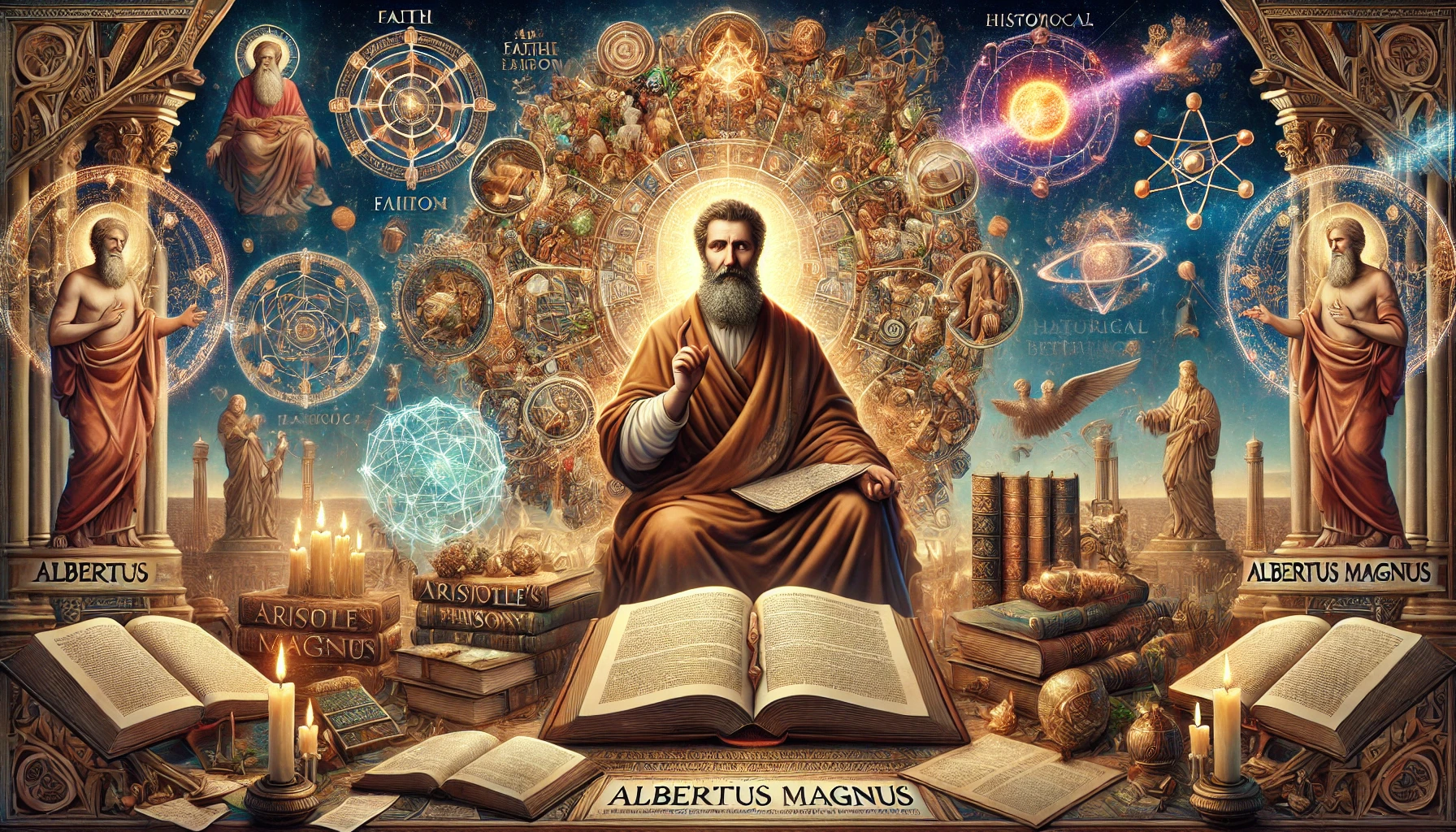
Albertus Magnus, or Albert the Great, stands as a towering figure of medieval
philosophy and theology. Born around 1200 in Lauingen an der Donau,
Germany, Albert was a polymath who explored subjects ranging from
metaphysics to zoology. Not only was he a prolific writer and thinker, but he
also played a pivotal role in shaping the intellectual landscape of his era. As
the teacher of Thomas Aquinas, Albert left an enduring legacy within the
Dominican tradition and medieval philosophy as a whole (Führer, 2020)
Albert’s philosophical journey was marked by his dedication to reconciling
faith with reason. This synthesis, inspired by his study of Aristotelian thought,
sought to demonstrate that reason and divine revelation are not in
opposition but complement one another. His integration of classical
philosophy with Christian theology laid the foundation for the Thomistic
tradition, which would come to dominate medieval scholastic thought
(Austriaco, 2016).
One of Albert’s most profound contributions to philosophy is his work on
natural law, a concept that has influenced moral philosophy and theology
for centuries. Albert perceived natural law as an innate habitus, or habit,
imprinted on the rational human soul. This “habit” serves as a moral
compass, guiding individuals toward fundamental principles of good and
right. In his view, this moral framework is not merely learned but is intrinsic
to human nature, concreated with the soul itself (Greenwell, 2010).
Albert explained natural law through the lens of synderesis, a term he used
to describe the universal principles of natural right inscribed on the soul.
Synderesis, according to Albert, is the soul’s inherent ability to discern right
from wrong, acting as a motive force that informs moral decisions. He
elaborates on this in his Quaestio de synderesis, where he writes: “Synderesis is a certain kind of motive power in possession of the universal
principles of natural right, having something of knowledge and something of
appetition, but situated more on the side of knowledge” (Greenwell, 2010).
This profound insight suggests that human beings possess an innate
orientation toward moral truth, a natural inclination to act rightly, even as
they wrestle with competing desires and circumstances.
Albert also explored the role of practical reasoning in moral decision-making.
He argued that the inner habitus—our conscience—not only guides us toward
the good but also enables us to apply universal principles to specific
situations. Through the syllogism of practical reasoning, individuals use their
innate moral compass to navigate the complexities of ethical life. This
framework underscores the dynamic interaction between universal moral
principles and personal decision-making.
Albertus Magnus’s work on natural law and synderesis did not fade with his
passing. His ideas were carried forward through the Thomistic tradition,
which expanded and refined his philosophical principles (Austriaco, 2016). By
emphasizing the compatibility of faith and reason and the universality of
moral law, Albert’s teachings remain relevant in contemporary discussions of
ethics, theology, and human nature.
Albertus Magnus’s life and work illuminate the enduring human quest to
understand the divine, the natural world, and ourselves. His synthesis of
faith, reason, and morality continues to inspire thinkers across disciplines. In
exploring his contributions to natural law, we are reminded of the timeless
truths that unite humanity’s shared intellectual and spiritual heritage.
Führer, M. (2020). Albert the Great. The Stanford Encyclopedia of Philosophy
(Summer 2020 Edition), Edward N. Zalta (ed.). Retrieved from Stanford
Encyclopedia of Philosophy.
Austriaco, N. P. G. (2016). Albertus Magnus and the Integration of Faith and
Sciences. Providence College. Retrieved from YouTube lecture.
Greenwell, A. M. (2010). St. Albert the Great: The Natural Law and Practical
Reasoning. Lex Christianorum. Retrieved from Lex Christianorum.