
The sand mandalas of Tibetan Buddhism are among the most exquisite and
profound expressions of spiritual art. Intricate patterns formed from colored
sand, these mandalas are a testament to the dedication and spiritual
discipline of the monks who create them. But beyond their visual beauty lies
a powerful message: an invitation to reflect on the impermanence of all
things and the Buddhist concept of non-self.
The creation of a sand mandala is an arduous process that begins long
before the first grains of sand are laid. The design is meticulously planned,
often based on sacred geometric patterns or representations of Buddhist
cosmology. The monks, having undergone years of training, approach the
task with deep concentration and mindfulness.
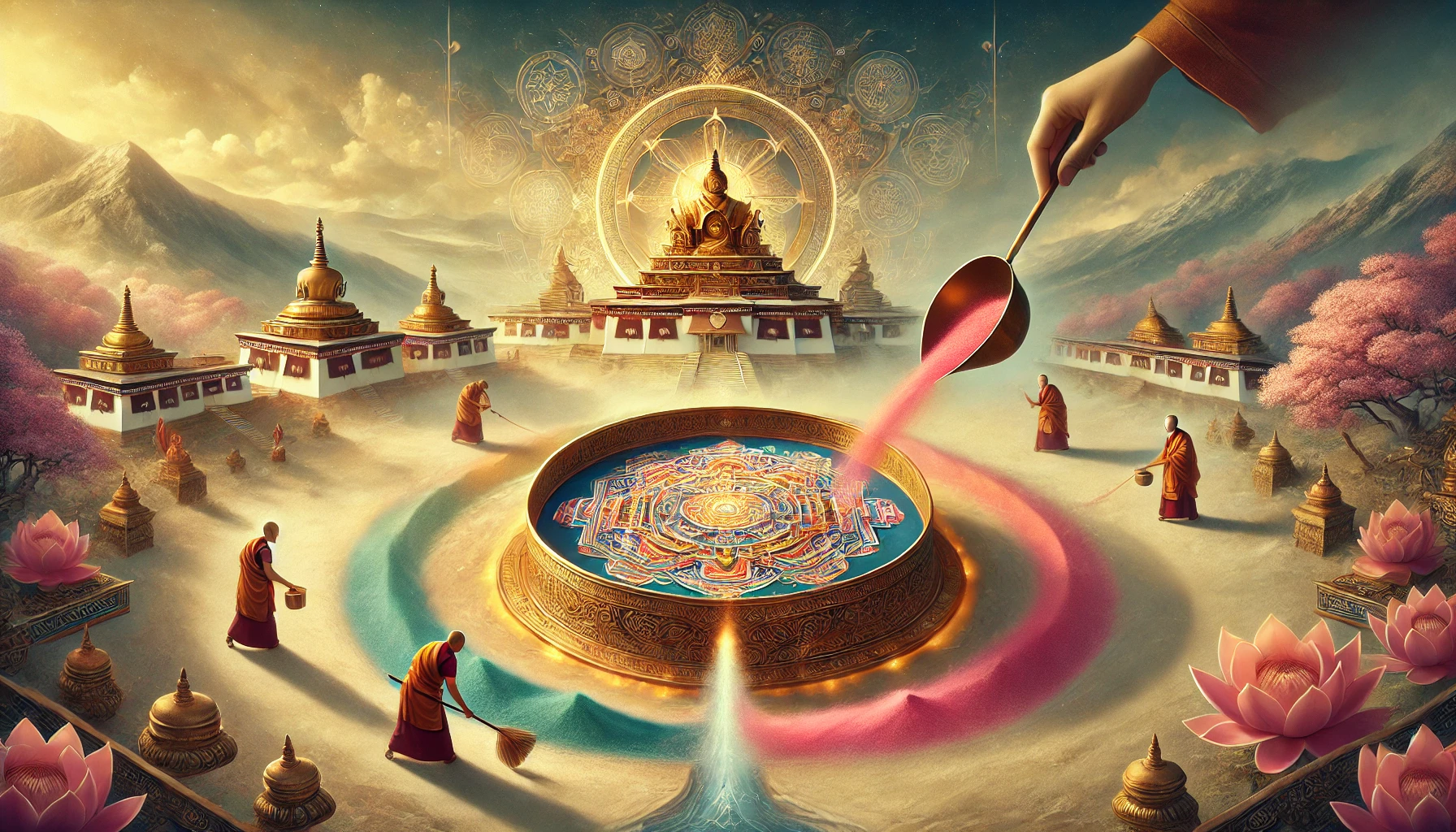
Using chak-pur—copper funnels that allow the sand to flow in fine streams—
the monks painstakingly apply the colored sand to the design. Each stroke,
each placement of sand, is performed with intention and focus. This
meditative process transforms the act of creation into a spiritual practice,
allowing the monks to embody the principles of patience, mindfulness, and
dedication
When the mandala is completed, it is not preserved as one might expect.
Instead, it is prayed over and then ceremoniously swept away. This act,
though seemingly counterintuitive, embodies one of Buddhism’s central
teachings: the impermanence of all things.
Impermanence, or anicca, is a cornerstone of Buddhist philosophy. Just as
the mandala, despite its beauty and the labor that went into its creation, is
impermanent, so too is everything in life. The act of sweeping away the sand
is not a destruction but a reminder that clinging to permanence is a source of
suffering. By releasing attachment to the mandala, practitioners are
encouraged to reflect on their own attachments in life and the transient
nature of existence.
The temporary nature of the mandala parallels the Buddhist concept of
anatta, or non-self. According to Buddhist teachings, the self is not a fixed,
eternal entity but a collection of causes and conditions, known as the five
skandhas: form, sensation, perception, mental formations, and
consciousness. These aggregates combine to create what we perceive as
“self,” but they are ever-changing and dependent on external conditions.
Similarly, a sand mandala is an aggregate of countless grains of sand,
brought together to form a cohesive and beautiful whole. But just as the
mandala is swept away, the self, too, is impermanent. Holding onto the
illusion of a permanent self leads to suffering, as it conflicts with the
fundamental truth of change.
By engaging in the deliberate and intricate process of creating a mandala,
monks meditate on these truths. The art becomes a spiritual exercise, a
reminder that just as the mandala dissolves, so too will the self eventually
pass away, leaving behind only the karma of one’s actions.
The sand mandala is more than an art form; it is a profound teaching tool. It
speaks to anyone willing to listen to its message, encouraging us to confront
our attachments, recognize the impermanence of life, and embrace the
freedom that comes from letting go.
In a world often preoccupied with permanence—whether through
possessions, relationships, or even identity—the mandala offers a
countercultural perspective. Its beauty lies not only in its creation but in its
impermanence, challenging us to appreciate the present moment without
grasping for permanence.
The sand mandala, with its intricate design and transient existence, is a
poignant reminder of life’s fleeting nature. It invites us to practice
mindfulness, to let go of attachments, and to reflect on the
interconnectedness of all things. Through its creation and dissolution, the
mandala embodies the essence of Buddhist teachings, offering a path toward
greater understanding and inner peace.
As the sands are swept away, they carry with them the message of
impermanence, leaving behind not emptiness but a profound sense of
freedom and acceptance—a lesson for monks and lay practitioners alike.